 munimly
Easy English · 7 minute read
What is CMA data?
CMA data is a set of business numbers that helps a bank understand your loan need and repayment ability.
CMA data bank ko aapke business ki sales, kharcha, stock, loan need aur payment capacity samjhata hai.
- Business records
- CMA report
- Bank review
By Munimly · Updated
CMA means Credit Monitoring Arrangement.
Why does the bank ask for CMA data?
The bank wants to understand how money moves through your business. Sales alone do not show when you receive cash.
You may buy goods today and sell them on credit. Until customers pay, your money stays tied up in daily business.
Working capital is money needed for stock, customer credit, and daily expenses. CMA data helps explain this need to the bank.
Maal kharidne aur customer se payment milne ke beech paisa chahiye. Isi roz ke business ki zaroorat ko working capital kehte hain.
The bank uses the report to check four practical things:
- What your business earned and spent in past years.
- Why you need the loan amount you are requesting.
- Whether future sales and cost estimates have a clear basis.
- Whether the business can pay interest and repay loans.
Ask your bank for its format and required years first. Different banks and loan requests can need different details.
What do the CMA forms show?
Each form shows one part of your business finances. Together, they connect your accounts, future plans, and loan request.
Munimly's sample report has nine forms, arranged across several years. Your bank may use different form names or a different layout.
A balance sheet shows what your business owns and owes on one date.
- Past results
- What the business earned and spent before.
- Future estimate
- Expected sales, cost, profit, and balance sheet.
- Working capital
- Money needed for stock, customer credit, and daily work.
- Loan position
- Existing loans, proposed loan, and repayment ability.
A profit and loss statement shows income, expenses, and profit over time.
Actual figures come from accounts for a completed period. An estimate is your expected result for the current year.
Projections are your expected figures for later years. Explain what supports them, such as orders or recent sales.
Actual mein beetey saal ke accounts aate hain. Estimate aur projection mein aaj ki jaankari se aage ka andaza lagate hain.
The forms also compare numbers through ratios, such as profit against sales. These comparisons help readers notice changes that need an explanation.
Read the Maximum Permissible Bank Finance (MPBF) example to see how Munimly assesses working-capital finance.
What do Kaveri's sales and balances show?
Kaveri Office Supplies is a fictional business with annual sales of ₹120 lakh, or ₹1.20 crore. Some of its money is tied up in stock and unpaid customer bills.
Stock means goods still available for sale. Debtors are customers who still have to pay you.
Creditors are suppliers whom your business still has to pay.
| Business number | Amount |
|---|---|
| Annual sales | ₹120 lakh |
| Stock at year-end | ₹20 lakh |
| Debtors at year-end | ₹15 lakh |
| Creditors at year-end | ₹8 lakh |
Kaveri has money in goods and unpaid customer bills. Supplier credit supports part of this daily business need.
Annual sales of ₹120 lakh do not mean ₹120 lakh in cash. Some customers have not paid, and business expenses also need payment.
Sales ka poora paisa bank mein nahi hota. Kuch paisa stock mein hota hai, aur kuch customer se aana baaki hota hai.
These four figures alone cannot show how much the bank may lend. The bank needs the full accounts, estimates, and other loan details.
CMA is only a profit and loss statement.
CMA joins past accounts, future estimates, working capital, and loan details.
How does a CMA report differ from a project report?
A CMA report focuses on connected business numbers for bank review. A project report can explain the wider plan behind a new project.
- CMA report
- Past accounts, future estimates, working capital, loans, and repayment ability.
- Project report
- Business idea, market, project cost, machinery, funding plan, and starting schedule.
Kaveri may need CMA data for a working-capital loan review. A new warehouse project may also need a project report.
Ask the bank which reports it needs for your proposal. Preparing one does not automatically replace the other.
What should you keep ready?
Collect your source records before entering any business numbers. Check the bank's list for required years and extra documents.
- Financial statements
- Balance sheets and profit and loss accounts for past years.
- Sales and tax records
- Sales register and Goods and Services Tax (GST) returns, where applicable.
- Bank statements
- Account entries showing money received, payments, and loan transactions.
- Stock and customer details
- Goods held, unpaid customer bills, and amounts owed to suppliers.
- Loan details
- Existing loan balances, approval letters, interest, and repayment schedules.
For example, check Kaveri's ₹15 lakh debtors against unpaid customer bills. Check which bills are old, disputed, or already paid.
Keep current-year accounts and notes supporting future estimates ready too. Explain sales growth using records, rather than choosing a bigger number.
Federal Bank's business-loan checklist includes financial statements and CMA data for specified cases. Your bank's requirements may differ.
Check the amount unit before typing. If a field needs rupees, enter ₹20 lakh as 2000000.
Keep past accounts separate from estimates and future projections. If a balance is unclear, ask your accountant before submitting.
How do you prepare a CMA report in Munimly?
Enter your accounts and future estimates. Munimly links them across the CMA forms so you can review and download the report.
Read the step-by-step CMA preparation guide when your records are ready. The calculation methodology explains how Munimly uses your figures.
The sample uses FY, meaning financial year, from April to March. FY24-25 covers April 2024 to March 2025.
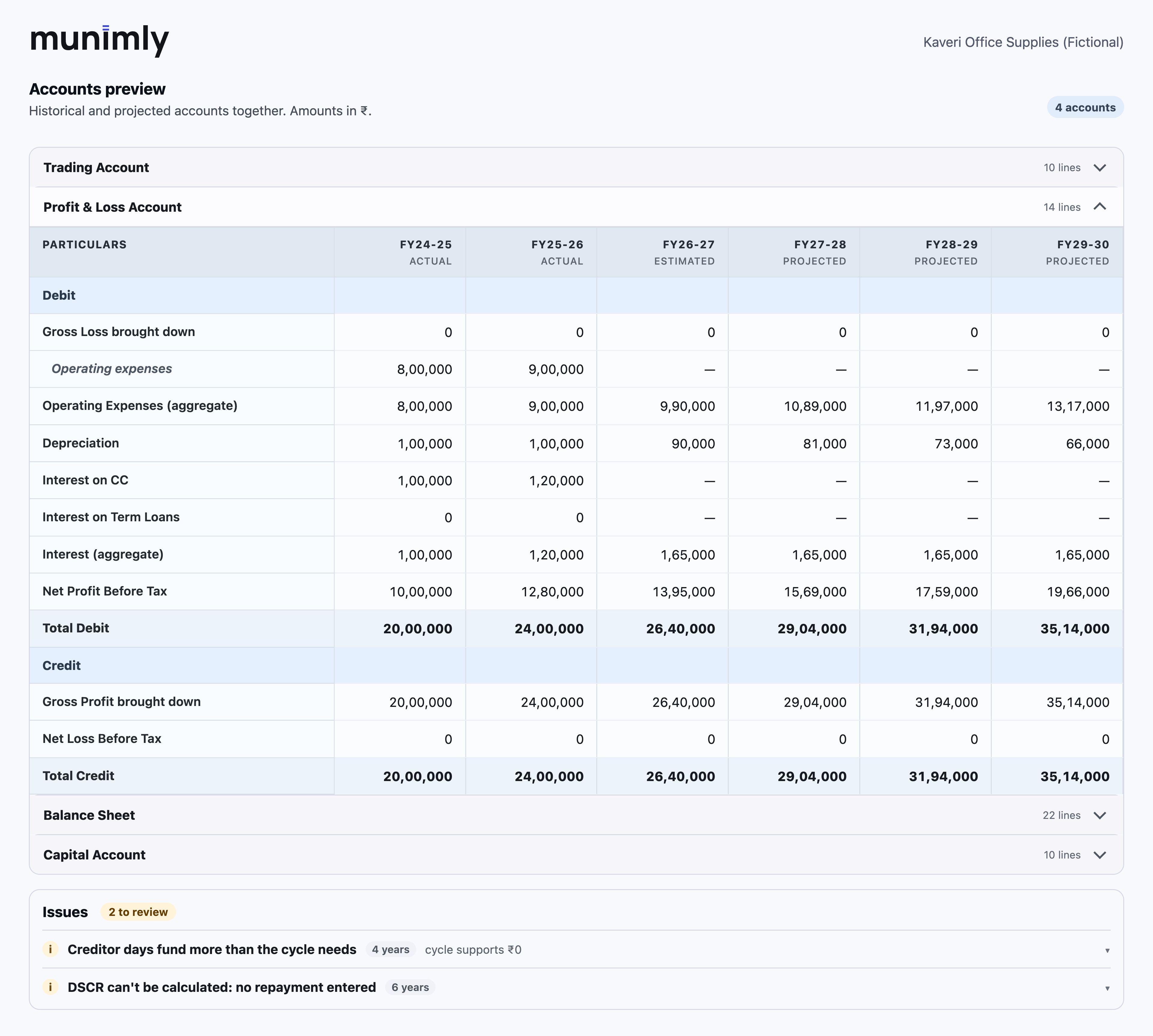
- Top heading, Accounts preview: this screen brings past accounts and future estimates together.
- Year columns below the account headings: actual means completed years, estimated means this year, and projected means later years.
- Account rows under the year columns: read across each expense or profit row to compare years.
Review source records and estimates before sharing your report. Software checks cannot confirm whether your business figures are true.
The Excel sample contains fixed values. Download the Excel sample or view the full CMA report example.
Munimly numbers ko report mein jodta hai. Sahi accounts aur sachche estimates dena aapki zimmedari hai.
CMA data recap
- CMA arranges your business numbers in connected forms.
- Banks use it to review loan need and repayment ability.
- Honest source records matter more than a good-looking report.
Common questions about CMA data
What does CMA data mean?
CMA means Credit Monitoring Arrangement. It arranges business numbers so a bank can review your loan need and repayment ability.
Who can prepare CMA data?
A business owner, accountant, or chartered accountant can prepare the figures. Ask your bank whether a chartered accountant must review or sign it.
Which documents do I need?
Keep financial statements, sales records, bank statements, stock and customer balances, and loan details ready. Your bank may ask for more records.
Does CMA data guarantee bank approval?
No, CMA data helps the bank review your business. The bank decides after checking your proposal and supporting records.
Should I update CMA data every year?
Update it when your bank asks for a yearly review or renewal. Use fresh accounts and check future estimates each time.