 munimly
Easy English · 8 minute read
MPBF calculation in simple words
MPBF is the highest working-capital amount a bank may assess from your business numbers.
MPBF bank ka assessed amount hai. Final sanction isse kam bhi ho sakta hai.
By Munimly · Updated
The full name is Maximum Permissible Bank Finance (MPBF).
Working capital is money that keeps your daily business running. It helps you buy goods while waiting for customers to pay.
Cash credit (CC) is a bank borrowing facility for daily business needs. The amount you can use depends on the bank's conditions.
How does Nayak use the 25–5–20 split?
Munimly's Nayak example sets working-capital need at 25% of annual turnover. The owner contributes 5%, leaving an assessed bank share of 20%.
Turnover means your business's total sales for a period. Projected annual turnover means the sales you expect over one year.
Saal ki ₹100 sales par ₹25 ki zaroorat maani gayi hai. Ismein ₹5 owner ka hissa aur ₹20 assessed bank share hai.
25% need = 5% owner contribution + 20% assessed bank share
- O = owner: 5 blocks out of 100 turnover blocks.
- B = assessed bank share: 20 blocks out of 100.
- Unmarked: 75 turnover blocks outside this working-capital calculation.
The Reserve Bank of India (RBI) describes when this split applies in its 2023 guidance for urban co-operative banks, section 2.
Appraisal means the bank checks your business and borrowing need. The RBI's small-business credit FAQ, question 7 explains why business cycles matter.
Your business cycle runs from buying goods to receiving customer payments. A longer wait can change your need for working capital.
Follow Kaveri's ₹100 lakh example
The fictional business Kaveri Office Supplies expects ₹100 lakh in annual sales and requests ₹18 lakh in CC.
₹100 lakh equals ₹1 crore. We use lakh throughout these calculations so you can compare amounts.
- Projected annual turnover
- Working-capital need: 25%
- Owner contribution: 5%
- Assessed bank share: 20%
- Requested cash credit
- Munimly recommendation: lower of ₹20 and ₹18 lakh
The arithmetic is ₹100 lakh × 25% = ₹25 lakh. Then ₹25 lakh − ₹5 lakh = ₹20 lakh assessed bank share.
Kaveri asked for ₹18 lakh, below the ₹20 lakh assessment. Munimly therefore recommends ₹18 lakh, the lower of these two amounts.
This recommendation follows Munimly's calculation method and is not loan approval. The bank still decides the sanctioned amount after appraisal.
Assessment ₹20 lakh hai, par Kaveri ne ₹18 lakh maanga. Munimly ka recommendation ₹18 lakh hai; bank approval abhi baaki hai.
How does Tandon Method II compare with Nayak?
Tandon Method II starts with current assets and other current liabilities. Nayak starts with sales expected over a year.
- Current assets
- Cash, stock, and customer payments expected within the normal business cycle.
- Other current liabilities
- Short-term amounts owed, such as supplier bills, excluding bank borrowing here.
For Kaveri, stock means office supplies held for sale. Unpaid customer bills are amounts customers still owe the business.
Current assets mein cash, stock aur customers se milne wala paisa aata hai. Yahan doosri liabilities mein bank borrowing shamil nahi hai.
| Nayak | Tandon Method II |
|---|---|
| Starts with projected annual sales | Starts with current assets |
| Bank share: 20% of turnover in this example | Bank share: 75% of current assets, less other current liabilities |
| Sets Munimly's recommended CC | Separate calculation in Munimly |
Under this method, long-term funds cover at least 25% of current assets. These are funds available for longer, such as the owner's capital.
This leaves 75% before subtracting other current liabilities. The RBI's historical account of Tandon Method II, footnote 29 explains this framework.
For a separate example, give Kaveri current assets of ₹60 lakh. Its other current liabilities are ₹12 lakh.
- 75% of current assets: 75% × ₹60 lakh
- Less other current liabilities
- MPBF under Tandon Method II
Existing bank cash credit is not included in these other current liabilities.
Subtract ₹12 lakh from ₹45 lakh to get ₹33 lakh. This separate result does not change Munimly's Nayak-based recommendation.
Tandon ka ₹33 lakh alag calculation hai. Isse Munimly ka Nayak recommendation badalta nahi hai.
How do the four amounts differ?
- Assessed amount
- The amount calculated from your business numbers using a chosen method.
- Requested amount
- The amount you ask the bank to lend your business.
- Recommended amount
- Munimly's lower amount: your request or its Nayak assessment.
- Sanctioned amount
- The amount the bank approves after checking your application.
- Assessed
₹20 lakh calculated - Requested
₹18 lakh asked for - Recommended
₹18 lakh in Munimly - Sanctioned
Bank decides after appraisal
Do not think
“MPBF means sanctioned limit.”
Remember instead
MPBF is an assessed amount; the bank sanctions after appraisal.
The RBI's credit FAQ, question 7 explains how the bank assesses actual business needs.
Read the drawing-power example to see how the sanctioned limit affects the amount you can withdraw.
Find the calculation in Form V
Open Form V of the Credit Monitoring Arrangement (CMA) report to see Munimly's Nayak calculation.
The existing Kaveri sample uses different figures from our lesson. It has ₹132 lakh turnover and a ₹15 lakh request.
In the screenshot, WC means working capital and “min” means lower amount. Borrower Margin means the owner's contribution to the working-capital need.
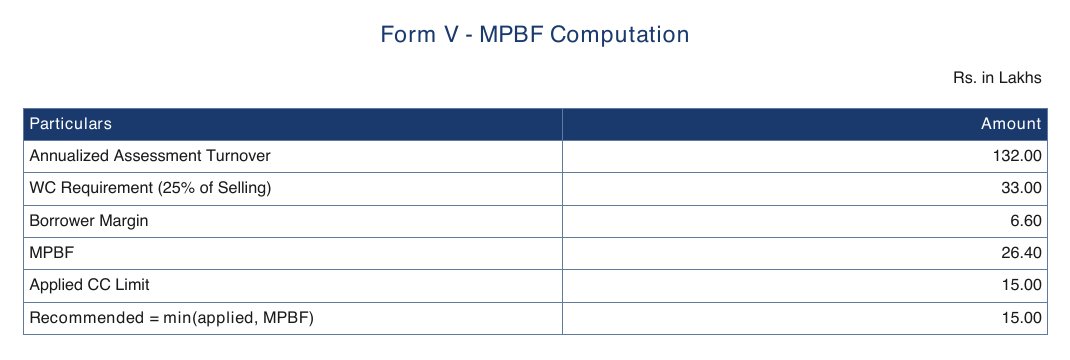
- Turnover row: ₹132 lakh annual sales starts this sample calculation.
- MPBF row: ₹26.40 lakh is the assessed bank share.
- Recommendation row: ₹15 lakh is lower than ₹26.40 lakh. It matches this sample's ₹15 lakh request.
Read the full fictional CMA sample to see its other forms. Use the preparation guide when gathering your own records.
MPBF recap
- MPBF is an assessment, not a bank approval.
- Munimly recommends the lower of Nayak assessment and request.
- The bank decides the sanctioned amount after appraisal.
Common questions about MPBF
What does MPBF mean?
MPBF means Maximum Permissible Bank Finance. It is an assessed amount, not a bank approval.
What is the Nayak calculation here?
Munimly's example uses 25% of turnover as working-capital need. The owner contributes 5%, leaving an assessed bank share of 20%.
How is Tandon Method II calculated?
Take 75% of current assets, then subtract other current liabilities. Existing bank cash credit is excluded from those liabilities.
Why does Munimly recommend ₹18 lakh in the example?
Kaveri requests ₹18 lakh while its Nayak assessment is ₹20 lakh. Munimly recommends the lower amount, ₹18 lakh.
Does the bank have to approve the MPBF amount?
No. The bank decides the sanctioned amount after its appraisal.